♥ disrupting rape culture and paving the path forward ♥
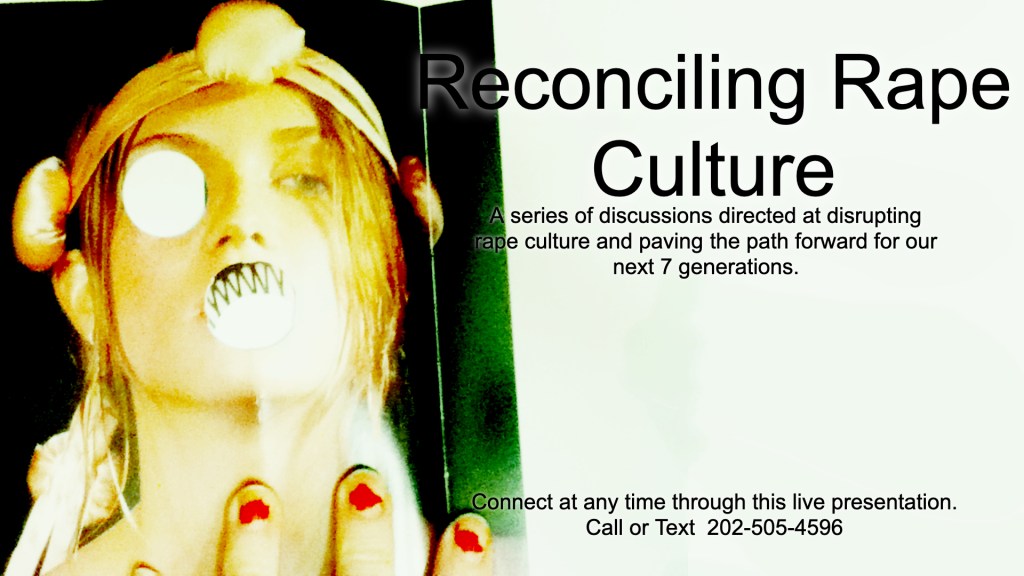
Participate in the conversation.
Each Saturday, February 27th – March 27th from 7-8pm
Join us live or watch again on YouTube
SUPPORT THE CONVERSATION
Give what you can, when you can.
100% of donations went to fund panel participants for their time and expertise.
All surplus funds were donated directly to HIPS, a DC based organization promoting the health, rights, and dignity of individuals and communities impacted by sexual exchange and/or drug use due to choice, coercion, or circumstance.
Reconciling Rape Culture is a series of discussions directed at disrupting rape culture and paving the path forward for our next 7 generations. The five segments in the series will be hosted by a primarily BIPOC team of creatives and activists, and they will be joined by experts in the field and guest members of the Catharsis creative community. We will begin shooting the segments on Saturday, February 27th, with all organic discussions available on a live stream. The conversations will be edited into one complete release after all five segments are recorded, with the intended release by May 2021, as a supplement to National Mental Health Awareness Month. The first segment will be all about functional tools for addressing trauma, including the most recent epigenetic research as written by Resmaa Menakem. We will use this segment as an anchor for all future conversations in order to re-embody viewers and participants when the conversation becomes challenging or in their own personal experiences outside of this conversation. The second segment will discuss the topic “What is in a name?” including conversations about linguistic science and culture. We intend to ask whether to name one’s lived experience is necessary for healing the trauma around that experience. The third segment, entitled “What is sex?” will talk about the potential perceptual variations around what actually constitutes sexual contact across the spectrum of LGBTQAI individuals in contrast to what our culture has come to know as heteronormative sex. The fourth segment, “What is consent?” seeks to educate the community about transitioning into a consent-based culture (remember, the 11th principle is currently just a proposition) and the challenges that may present themselves when the community seeks to be consent positive while actively altering consciousness. The fifth segment, “Reparations for Rape Culture,” will begin the discussion around what reconciling a violation of any type may look like, and where we can move in a legislative forum in order to create a safer world for our next seven generations.
Our experts
The Dream City Healing Co is a vast and diverse group of individuals dedicated to revolutionizing culture through the healing arts. Our belief is that each individual has the power to heal themself from the inside out, and that all beings are entitled to access the presently esoteric practices that may guide one’s way towards wellness. We believe that anyone who seeks it deserves this knowledge without being subjected to a financial caste system, and we are seeking to use this forum to create a cultural shift that would be of benefit to all beings impacted by American culture.
Velu Ochoa
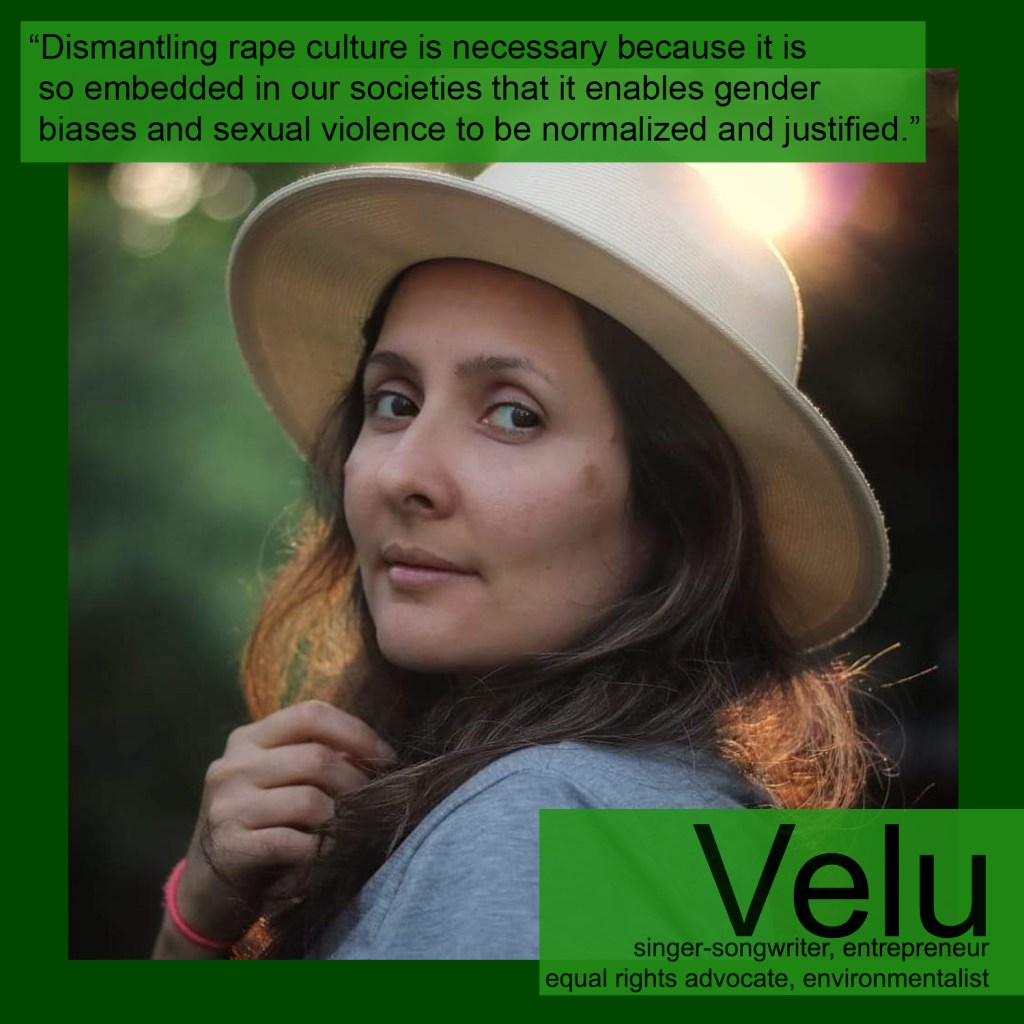
Velu is a woman of many trades. She is a singer-songwriter, entrepreneur, equal rights advocate, and environmentalist. Velu is part of the collective “Movimiento Púrpura DC Purple Movement DC. The collective is committed to the fight against gender violence and over the last 2 years has created spaces for women and allies to participate in empowering and educational events on gender equality
Velu is committed to diversity, equity, and inclusion values in all facets of her life. She believes that together, we are stronger.
“Dismantling rape culture is necessary because is so embedded in our societies that it enables gender biases and sexual violence to be normalized and justified.”
Tosin Akindele
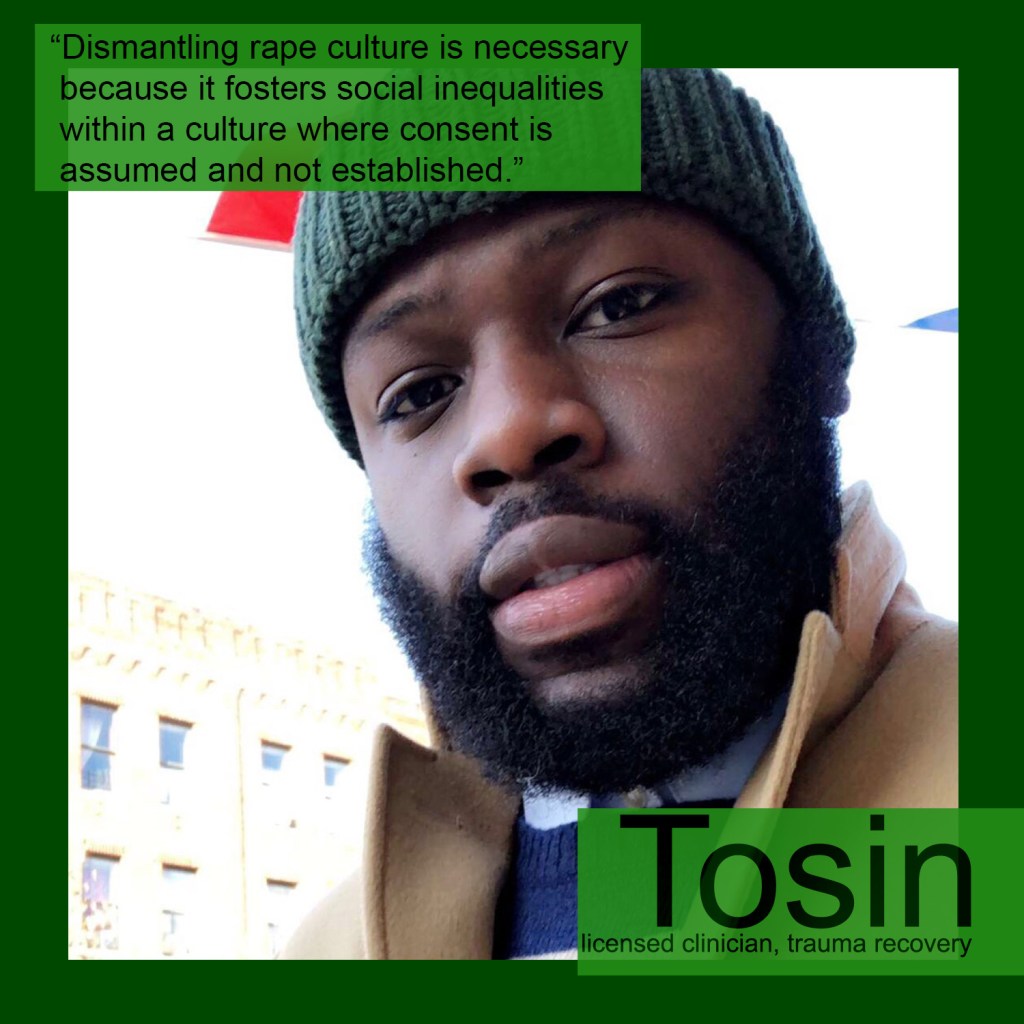
Tosin is a licensed clinician who is passionate about disrupting the negative stigma around mental health in communities of color. Upon earning his masters degree from the New York University Silver School of Social Work, he began his career in foster care, working to reunite youth with family resources and providing long-term permanency for youth aging out of care.
Understanding that mental health is directly correlated to an individuals physical and spiritual well-being, as a founding Social Worker at CCM’s Rubys Place, Oluwatosin deployed an overall wellness approach to treating clients who struggled with mental health and alcohol/drug addictions. He pioneered interventions that catered to clients emotional and spiritual wellbeing, physical and nutritional health, and mental wellness.
Tosin is a member of a team of trauma clinicians who facilitate weekends of recovery and days of recovery for male identified survivors of sexual abuse through Men Healing.
Currently, Oluwatosin works as a school social worker, providing psychotherapy to high school students dealing with mental and emotional hardships that directly effect their adjustment and performance in and outside of the school community.
“Dismantling rape culture is necessary because it fosters social inequalities within a culture where consent is assumed and not established.”
Tamika Spellman
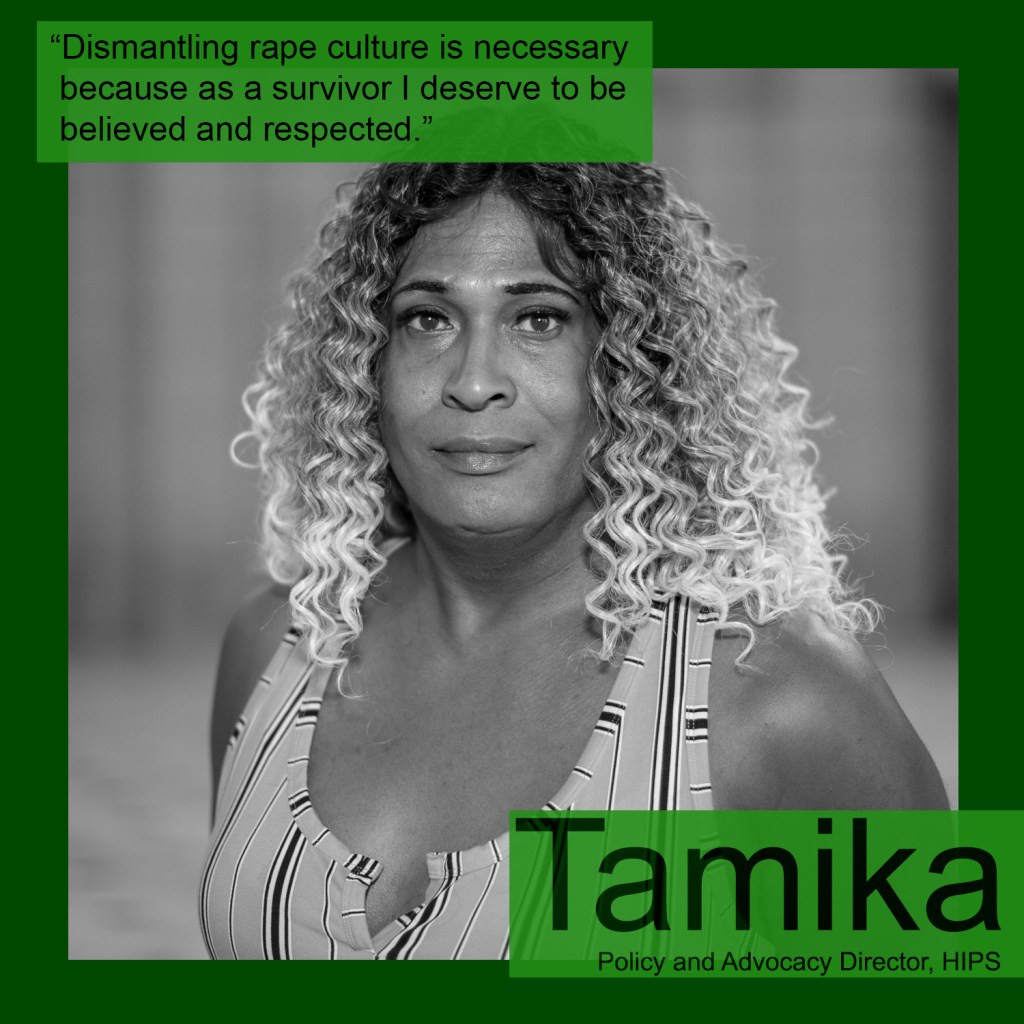
Tamika began working with HIPS in June 2017. She started volunteering with mobile services, then as a peer educator and with the secondary syringe exchange program, moved up to Policy and Advocacy Associate and is now the Policy and Advocacy Director. She is dedicated to helping and working to create positive policies and laws to help those engaging in sex work and drug use. She’s testified on behalf of HIPS at DC city council hearings, spoken on several harm reduction panels, and is managing SWAC (DECRIMNOW). She also serves as an advisor to the Sex Worker Giving Circle, the Chosen Few, No Justice No Pride, is a member of the Urban Survivors Union, and a board member for the Church Of Safe Injection-Bangor Maine. She also has featured op eds in The Root and Medium, appears in several articles and is the recipient of an award from the Legal Society of Washington D.C. for work on the fare evasion bill. She also advised congressional representatives Aynna Pressely and Ro Khanna on proposed legislation. Tamika has grown into being a featured speaker in the harm reduction arena. HIPS is extremely honored to have Tamika as our Policy and Advocacy Director.
“Dismantling rape culture is necessary because as a survivor I deserve to be believed and respected.”
Su Tin
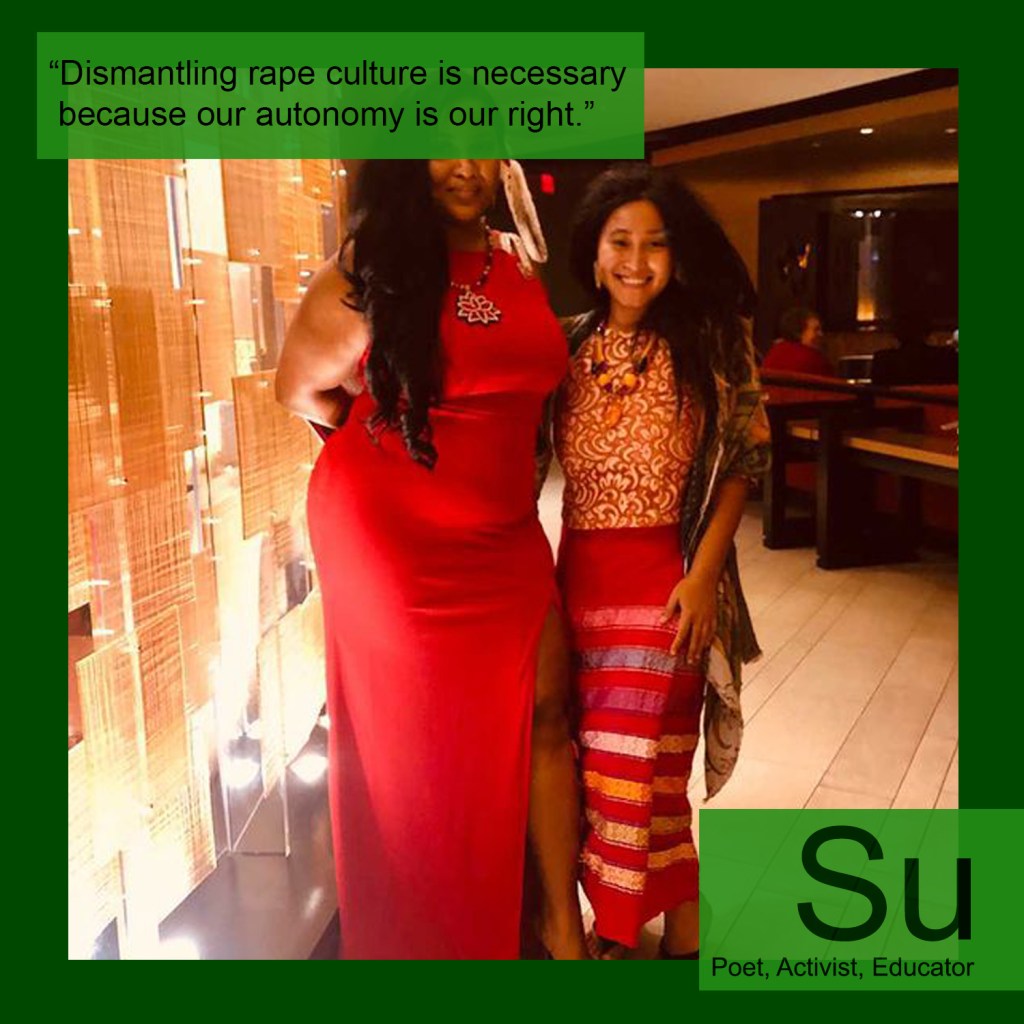
Thet-Su Tin (Su) “Life is Within Me and It Is Put Up On a Pedestal” is proud of her work as a petitioner in California which resulted in the passing of two bills: one making it illegal to have minors from 13-17 be charged as adults, and one requiring the testing of DNA evidence of deathrow inmates. Through her work in activism at protests and demonstrations she has connected with individuals whose lives have been saved through the passing of these bills.
Originally from Myanmar, she spent time in Chang Mai, Thailand helping to educate children who have also been effected by war and conflict, as well as supporting women who were victims of sex trafficking. She is currently a part of the Missing and Murdered Indigenous Women campaign, seeking justice in a legal system that creates incredible challenge when prosecuting violent offenders.
“Dismantling rape culture is necessary because our autonomy is our right.”
Stephanie Jones

Stephanie Jones is proud to work for the worlds greatest Navy as a hospital corpsman, Nationally Certified Psychiatric Technician level 3 & certified nurses assistant. She is honored to have recently become a sexual assault prevention response team advocate for the Navy at Walter Reed Army Medical Center. She is currently pursuing a nursing degree with a minor in psychology. Stephanie comes from a family of healers (social workers, nurses and behavior analysts) and is proud to be carrying on the tradition of working to heal people and in turn the larger society. She believes it is important to learn how people think and to understand their motivations in order to empathize and approach with the most effective healing practices. Her dream is to be an officer in the Navy and to continue finding new avenues and ways to help people on that path.
“Dismantling rape culture is necessary because unfortunately rape effects everyone. So it needs to be an everyone issue not just an issue to the people who are survivors of this tragic event.”
Melly Huang
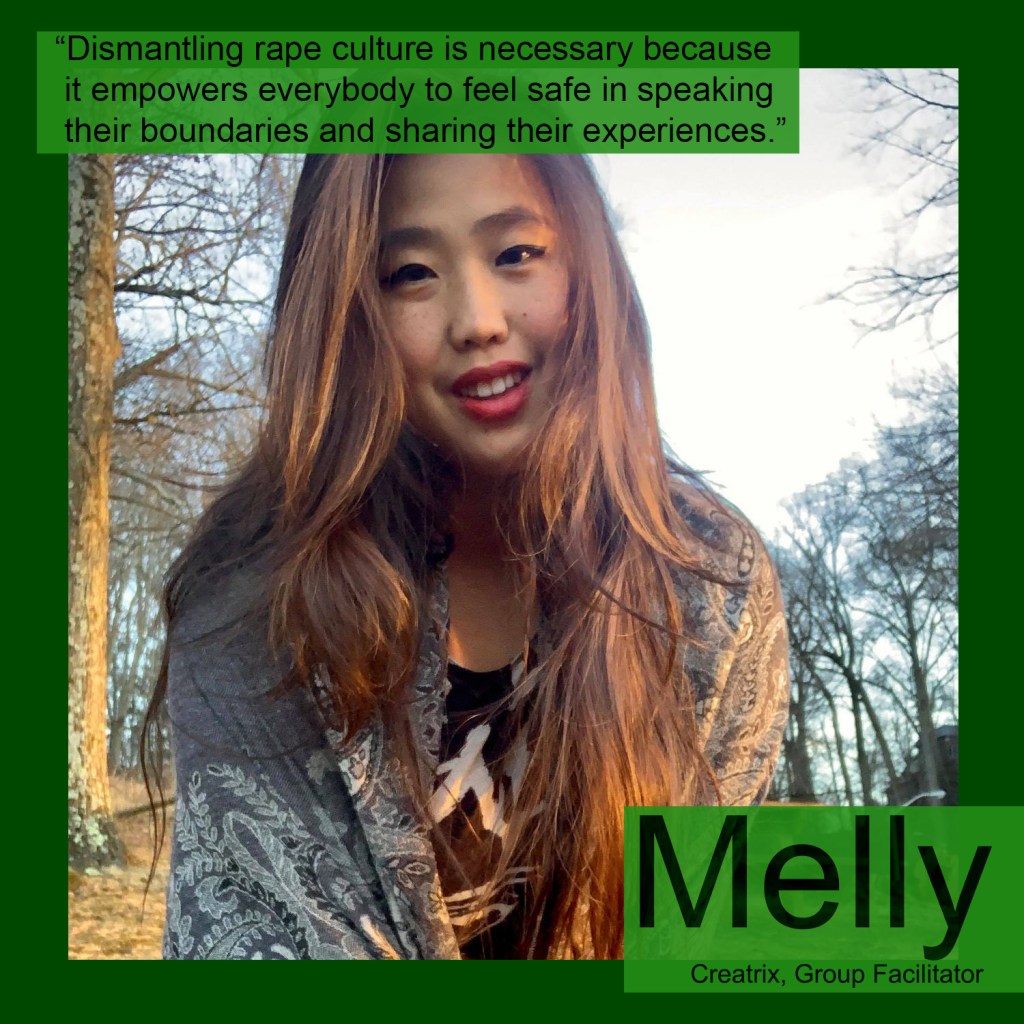
Melly Huang is a Creatrix who works with individual clients to unblock creativity and stay accountable to creative goals. Melly is currently a Master’s student studying Clinical Professional Counseling. Melly has past experience working with and leading groups for various trauma populations such as homelessness, torture, and substance use. Surrounding sexual violence, Melly has worked at CARE to stop violence at UMD as a peer advocate and at a domestic violence shelter as a case manager and group facilitator. Melly is starting a Sexual Assault Healing Circle for survivors of sexual violence. For more information regarding the group, please email her at SAhealing@dreamcityhealing.co
“Dismantling rape culture is necessary because it empowers everybody to feel safe in speaking their boundaries and sharing their experiences.”
James Landrith
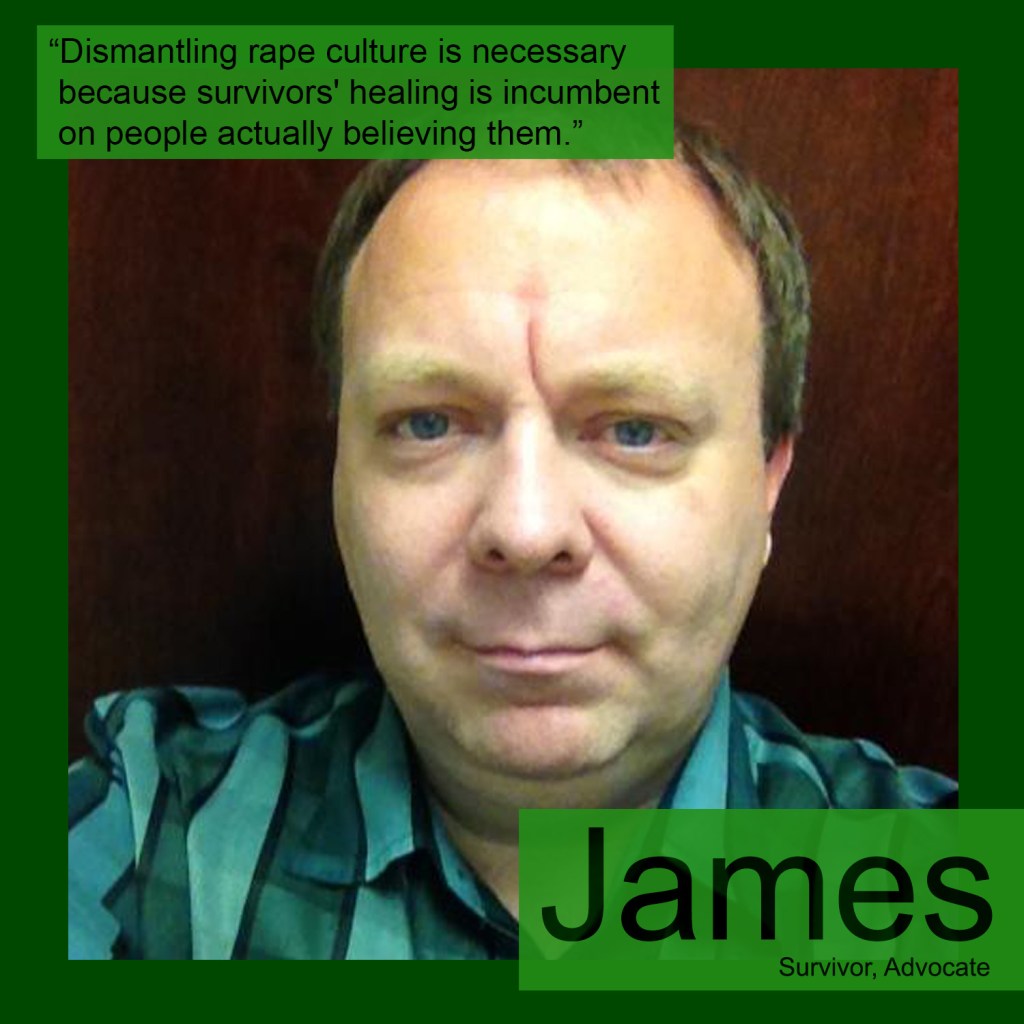
James started as a moderator on Pandora’s Aquarian, and then moved into the Virginia Sexual and Domestic Violence Action Alliance where he served on some committees and caucuses. He joined the RAINN speakers bureau in 2008. He has worked as a supervisor on the Safe Help line.
“Dismantling Rape Culture is necessary because survivors’ healing is incumbent on people actually believing them.”
Erin Jones
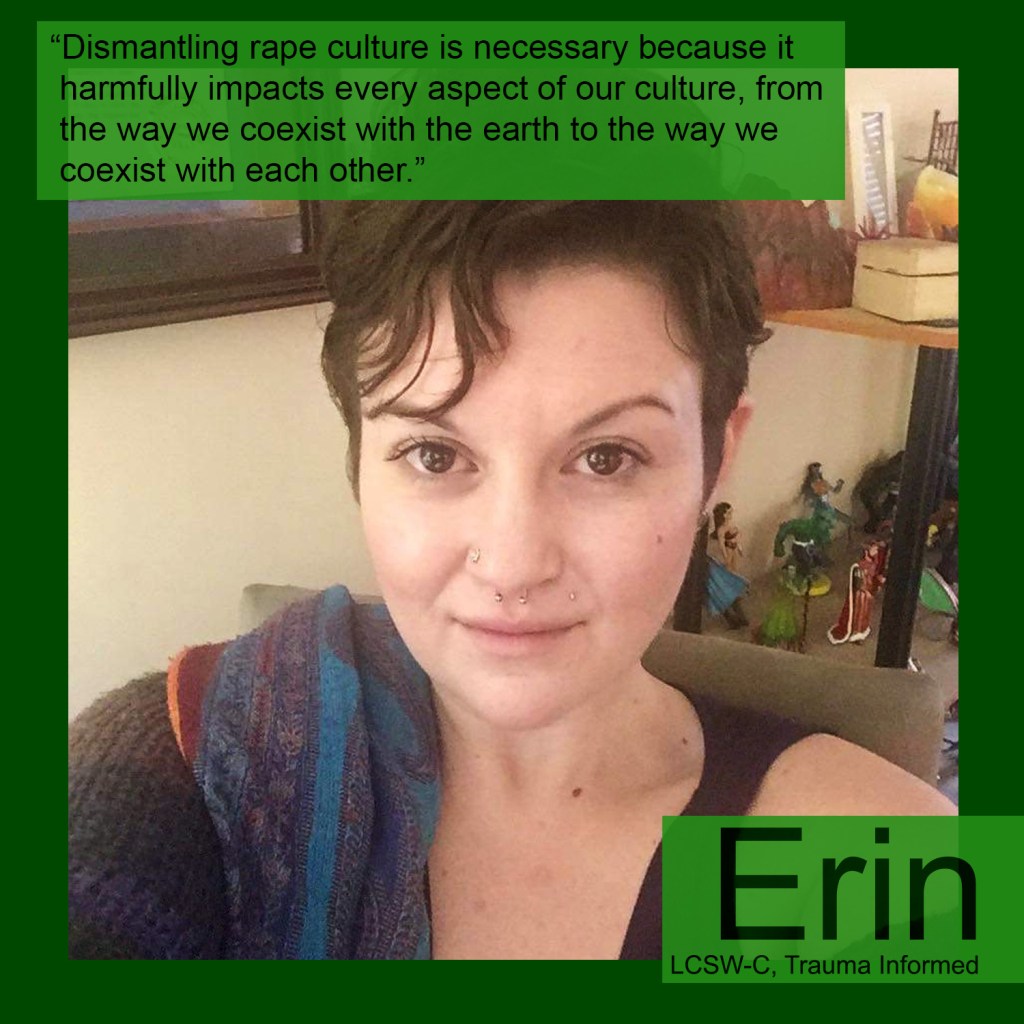
Erin Jones, LCSW-C, is a graduate of Washington College & The University of Maryland at Baltimore School of Social Work. She holds a BA in Clinical Psychology and a Masters in Clinical Social Work and is a certified integrative mental health practitioner. Erin has 20 years of experience in the field of mental health. Her path has taken her from working with adult psychiatric inpatient and co-occuring substance use clients, to adolescents in transitional living group care, level 5 schools, and treatment foster care, and currently to private practice with adults, couples and adolescents since 2015. Erin is passionate about de-colonizing and de-pathologizing mental health. She believes that embodied societal, individual, generational and ancestral traumas are the root source of most psychiatric illness and distress. She specializes in trauma, neuropsychology, and social justice informed psychotherapy grounded in integrative, somatic, and attachment based interventions. Her focus is on serving domestic abuse and sexual assault survivors, the LGBTQIA community, folx with chronic physical illness, other helping professionals, and folx practicing or curious about ethically non-monogamous and BDSM relationships. She is soon to be a board certified clinical supervisor and is transitioning her practice to provide nature & bilateral stimulation based walk/talk therapy, in-home therapeutic organization, and psychedelic integration sessions as adjuncts to traditional methods like SandTray, CBT, narrative and bibliotherapies. She hopes that it will allow her greater agency to further focus her efforts on dismantling white supremacy and rape culture through future collaborative radical a(c/r)tivism with Dream City Healing Co. & other kindred souls in her communities.
“Dismantling rape culture is necessary because it harmfully impacts every aspect of our culture, from the way we coexist with the earth to the way we coexist with each other.”
Alex Bradley
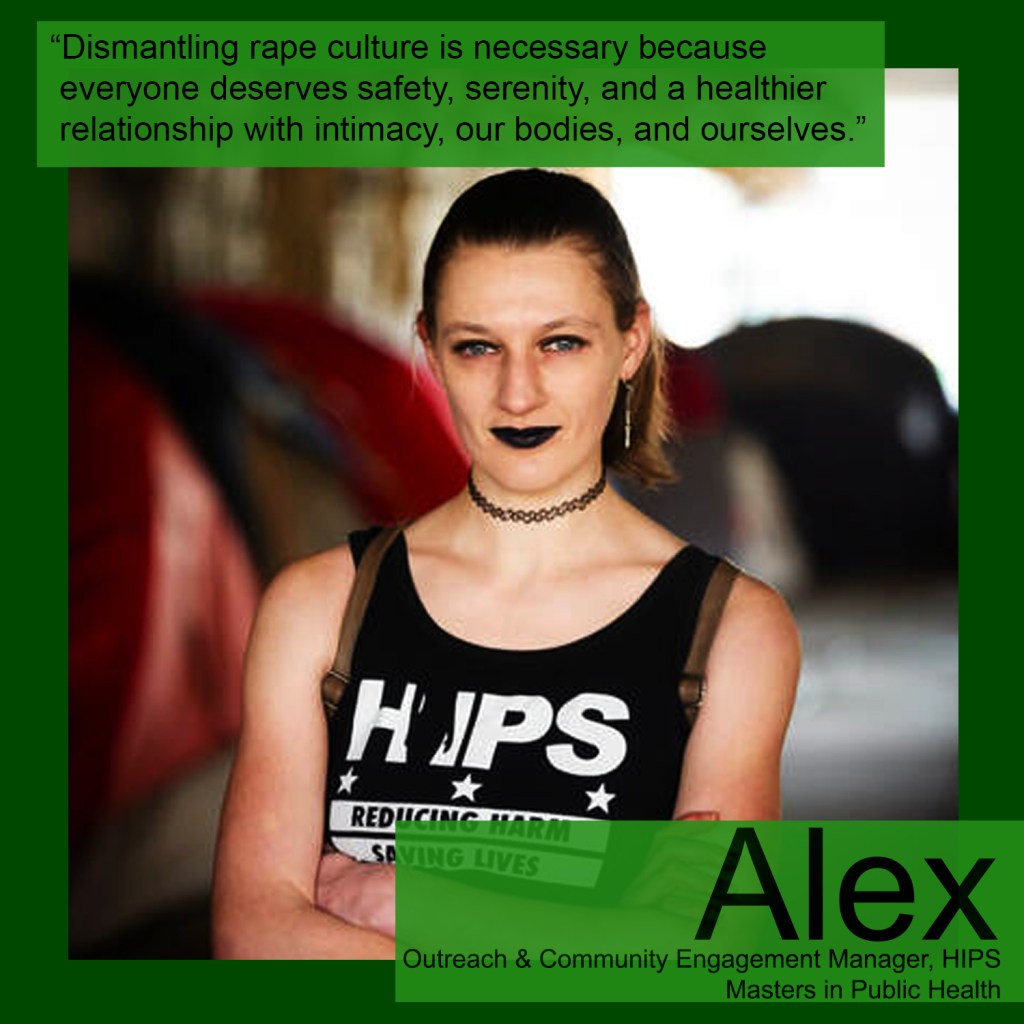
Alexander/a (Alex) Bradley started at HIPS in 2015 as an overnight outreach volunteer and is now responsible for coordinating and managing all of HIPS mobile services programs — including sex worker mobile outreach, syringe exchange, 24-hour hotline, and overdose prevention services — as well as the staff, volunteers, and interns who work on them. Prior to joining HIPS, Alex spent close to five years engaging in crisis response for survivors of sexual assault and domestic / intimate partner violence with organizations such as the Rape, Abuse, and Incest National Network (RAINN), the DC Rape Crisis Center, and DC SAFE. They earned an M.P.H. from The George Washington University and B.A.s in Psychology and Government from Cornell University. Outside of HIPS, Alex loves spending time with family, friends, and community; supporting and participating in local queer artistic events; running; and 80s music.
“Dismantling rape culture is necessary because everyone deserves safety, serenity, and a healthier relationship with intimacy, our bodies, and ourselves. Rape culture harms everyone by perpetuating trauma, re-enforcing harmfully rigid gender roles and norms, and getting in the way of our ability to express our fullest selves to each other.”
Our segments
Rape culture is a gangrenous wound within our American society. We need to take off the band-aid so readily used to cover the wound of rape so that it can be flushed appropriately, and then present functional tools for regenerating the nervous system so that it can recover, empowering instead of effacing the individual in their expression.
What is Trauma?
February 27th @ 7pm
In this segment we will be asking questions about the complex world of trauma. We hope to define what trauma is based on the latest clinical research, and explore the many tools currently being used at the cutting edge of healing complex trauma.
What’s in a Name?
March 6th @ 7pm
In this segment we will be asking questions about naming a lived experience. We hope to explore the concept of rape culture, and the value, if any, in calling a trauma by name.
What is Sex?
March 13th @ 7pm
In this segment we will be asking questions about sexual expression. We hope to explore the world of sexuality along a vast spectrum of experience, and how rape culture effects people differently based on their orientation and anatomy.
What is Consent?
March 20th @ 7pm
In this segment we will be asking questions about consent. We hope to explore what it means to participate in a consent-oriented culture, and how the concept of consent may change in certain circumstances.
Reparations for Rape Culture
March 27th @ 7pm
In this segment we will be asking questions about the path forward. We hope to explore concepts around what reparations — and sufficient preventions — for rape culture may look like.
Contact
We invite you to connect at any time if you have your own experience or feedback to offer.
You are not alone.
 Dream City Healing Co